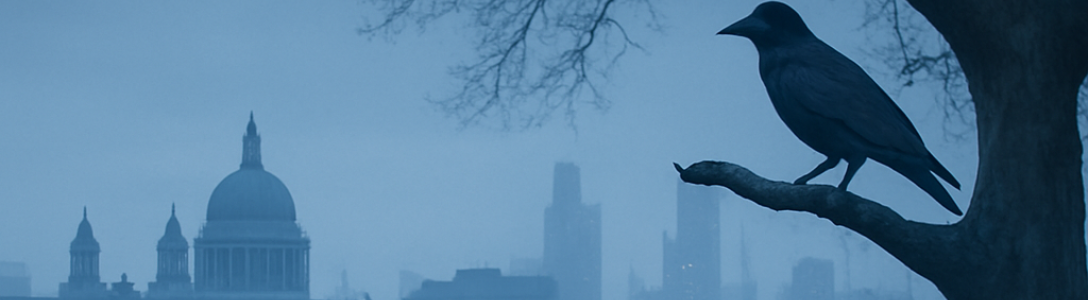
The first time I sat beside the Thames and felt its breath moving through me, I didn’t call it Druidry. I didn’t call it anything at all. There was no ritual, no robe, no sacred chant whispered into the wind. Just a stillness. A sense that I had stumbled into a conversation already in progress – between water and stone, current and moon, memory and presence. That moment wasn’t a beginning or an epiphany. But if I were to map my Druid path from here to there, it might be the place I’d draw the first spiral.
I’m often asked, now, what Druidry is. Not academically, not even always spiritually – just… what is it? Is it a religion? A philosophy? A kind of nature-based mindfulness? Something old and mysterious, or something new and made-up? And where do I, a queer neurodivergent man living in suburban London with a Labrador and a growing collection of fox folklore, fit into that?
This is my answer – or at least, a glimpse of it.
A Living, Breathing Path
Druidry today is a living path. It takes inspiration from the distant past but does not try to reconstruct it. While the ancient Druids of Iron Age Britain and Gaul are a source of fascination – and sometimes romanticisation – modern Druidry is not an attempt to become them. What we know of those original Druids is fragmentary, filtered through Roman accounts and later mythology. The Druidry I walk is something altogether different: a contemporary spiritual path rooted in reverence for nature, myth, imagination, and personal transformation. It is not fixed. It is not dogmatic. It breathes.
Some Druids are animists. Some are polytheists, some are pantheists, and some are humanists who find the sacred in story and landscape rather than deity. There is no creed. There are no commandments. What there is, more often than not, is a deep sense of kinship with the natural world. The sense that the Earth is not a resource, but a relative. That stories carry wisdom. That the turning of the seasons marks not just a passage through time, but a rhythm through which we come to know ourselves.
You’ll often hear Druidry described as a path of relationship. Not just to the land, but to the unseen – to spirit, to ancestors, to the energies that live between the words. It is a spirituality of listening, not declaring. Of spiralling inward and outward in equal measure.
Orders, Groves, and the Wider Druid Community
Modern Druidry comes in many forms, shaped by different teachers, orders, and solitary seekers. My own path winds through the Order of Bards, Ovates and Druids (also known as OBOD). It’s one of the largest Druid Orders in the world and offers a distance-learning course structured around three traditional grades: Bard, Ovate, and Druid.
Each grade invites you into a different focus of learning and practice. The Bardic Grade, which I completed recently, emphasises creativity, storytelling, and emotional healing. It reawakens a sense of wonder – of how myth, music, and metaphor can become acts of devotion. The Ovate Grade, where I now find myself, deepens the spiral. It brings attention to nature’s hidden patterns, to the cycles of life and death, to the role of seer and healer. It is slower, more liminal, and deeply attuned to the invisible currents running through the world.
One of the things I value most about OBOD is its openness. You are not told what to believe. You are offered a framework of teachings and practices – and encouraged to adapt, question, reimagine. For someone like me, who finds truth in fragments and meaning in metaphor, that flexibility is a gift.
But OBOD is only one part of the wider Druid community. There are other Orders – such as the Druid Network or ADF (Ár nDraíocht Féin) – each with its own emphasis. There are Groves, like my beloved Tamesis Grove in London, where people gather for seasonal rituals. There are festivals and podcasts and kitchen-table conversations. Druidry lives not only in circles of stone, but in circles of friends, fellow seekers, and solitary practitioners scattered across cities and coasts.
A Druid in the City
My own Druid path is bound to the city as much as it is to the wild. I don’t live in a woodland cottage or dance barefoot on ancient hills (though I wouldn’t say no to either). I live in a house in the suburbs and work in central London. I walk my dog along the same familiar paths each day. I feel the turning of the year in the way the air tastes on the morning commute, or how the shadows stretch differently on the brick walls near the train station. My Sacred Grove exists as an inner sanctuary – a place I return to in meditation, shaped by memory, intention, and imagination. In that Grove, I’ve sat beside a brook that didn’t appear until I was ready for it. Climbed a mountain that revealed itself only after I had spent years circling its base. Spoken with the fox who welcomed me at the edge of the wood, and who has since become a guide, a guardian, and a reflection of my own liminality.
I honour deities who speak to me through symbol and encounter. Brigid, with her flame of healing and inspiration. The Morrigan, fierce with truth and sovereignty. Cernunnos, the wild and rooted god whose presence is both grounding and sensual. They are not distant sky-beings demanding worship, but intimate forces woven into the land and into me.
As a queer man, I find in Druidry a spiritual path that honours my wholeness. There is no binary I must conform to, no gendered expectation I must perform. The myths and symbols are alive – and I am free to find myself in them. As someone with ADHD and autism, I am drawn to the sensory richness of ritual, the way Druidry invites me to experience rather than explain. I do not have to sit still in pews or follow rigid instructions. My practice can be flexible, embodied, and deeply intuitive. It can happen in the pause between thoughts, the flicker of a candle, the echo of birdsong at dusk.
I write, I walk, I sing, I sit in silence. Druidry gives me a framework, yes. But more than that, it gives me permission.
Not a Fantasy, Not an Escape
There are plenty of misconceptions about Druidry. Some imagine it as a fantasy cosplay of long robes and staff-waving pronouncements. Others dismiss it as a fringe curiosity – outdated, self-indulgent, or escapist. But Druidry, in truth, is neither playacting nor denial. It is a way of saying: this world matters. Not only the visible world of deadlines and digital noise, but the subtle world beneath it. The roots, the rain, the rhythms. The intuition that there is meaning in how the wind moves, or how a crow calls at the threshold of a choice.
It is not a religion in the way many people mean the word. There are no temples, no dogmas, no congregations. But it is sacred. And it is spiritual. And it is real.
You don’t need to be “Celtic.” You don’t need to know a single myth by heart or recite a single line of poetry. You don’t even need to call yourself a Druid. But if you have ever felt the world speaking softly to you, if you have ever looked at a tree and felt both known and unknown, you might already be walking the path, whether or not it has a name.
Becoming, Not Arriving
Druidry is not something I have become. It’s something I am becoming.
There is no certificate that says “you are done.” There is no mountaintop where you receive enlightenment and never doubt again. There is only the practice: of paying attention, of honouring the land and the life within you, of letting meaning emerge through myth, memory, and encounter.
Sometimes that looks like lighting a candle and whispering a prayer. Sometimes it looks like laughing in the rain. Sometimes it’s just remembering that you are part of something larger, older, and wilder than you know.
And sometimes – often, for me – it looks like standing at the edge of the Thames at dusk, watching the light catch the ripples, and knowing that this, too, is a kind of ceremony.

 The London Druid