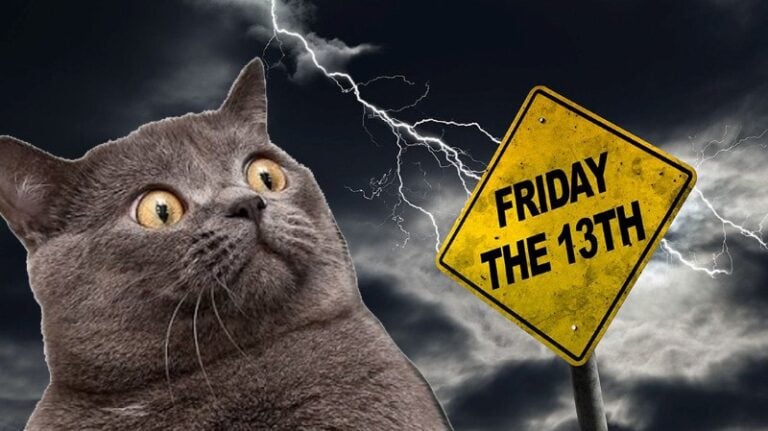
The calendar tells me it’s Friday the 13th. For many, this date carries an uneasy twinge – a day of ill luck, caution, or strange occurrences. Its reputation is rooted more in modern Western superstition than in ancient tradition, but as a Druid, I always find these cultural touchstones an interesting mirror of our collective psyche.
Numbers have always held meaning for humans. Thirteen unsettles some because it falls just outside the neat symmetry of twelve – twelve months, twelve zodiac signs, twelve hours on a clock face. Thirteen feels like a step beyond the known order, a hint of wildness. In that sense, it speaks rather beautifully to those of us who walk liminal paths. Druidry, after all, often dwells in those thresholds – neither one thing nor the other, but the rich space in between.
Some tie Friday the 13th to medieval Christian anxieties: the number of guests at the Last Supper, or the arrest of the Knights Templar on a Friday the 13th in 1307. But these are stories shaped by particular religious and political moments. For pre-Christian peoples of northwestern Europe, there’s little evidence that thirteen was feared. In some traditions, it was even sacred: a number connected to lunar cycles, with thirteen full moons in a solar year. The moon’s rhythms, so central to many earth-based practices, suggest that thirteen might more properly be seen as a number of fullness and continuity.
As for Fridays, the day itself was once associated with goddesses: with Frigg in the Norse world, and arguably with Venus through the Latin dies Veneris. In that light, Friday becomes a day of love, fertility, and mystery rather than misfortune.
So what does a Druid do with Friday the 13th? For me, it’s an opportunity. A reminder to notice the stories we inherit, and to choose consciously which ones we carry forward. Rather than avoid the day, I mark it as a moment to pause, acknowledge the old fears and folktales, and then step lightly through the threshold they create – as my ancestors might have done with any day touched by liminality.
In the end, the power we give to Friday the 13th – or to any symbol – lives not in the date itself, but in our relationship to it. And that, in many ways, is the heart of Druidry: the dance between symbol and meaning, between story and soul.
[EDIT] A Romanian friend told me just after publishing this post that in her cuture, it’s Tuesday 13th that carries the bad juju, while Fridays hold good energy instead. A nice reminder that every culture weaves its own patterns into the calendar – but the pull towards liminal meanings seems near universal.

 The London Druid
I think people forget sometimes that it wasn’t a 13th disciple who betrayed Jesus, it was one of the 12. And afterwards there were only 11 left, which spoils the symmetry a bit…
My birthday is a 13th (not June), so every few years it falls on Friday the 13th – not unlucky for me! An Italian colleague tells me that in their culture it’s Friday the 17th which is unlucky. Another example how it’s different in different cultures.
P.S. I’m WhiteHorseElin from the Hearth, had to log into my long abandoned WordPress account to comment here >_<
LikeLike